

Dropbox engineers have successfully trimmed their backend monorepo from a staggering 87 GB to just 20 GB. By addressing storage inefficiencies and Git delta compression models, the team significantly improved developer velocity and the efficiency of their continuous integration pipelines. This move was necessitated by scaling challenges within the repository, which serves as the primary integration point for backend services and shared libraries across the organization.
As the monorepo expanded over time, engineering teams began to suffer from glacial cloning operations that often exceeded an hour. Furthermore, CI pipeline performance degraded due to the overhead of repetitive download and build cycles. This rapid expansion also brought the repository dangerously close to platform storage limits. Investigations revealed that the primary culprit was not large binary files – but rather the way Git’s internal heuristic algorithms handled large sets of related files.
Git typically utilizes delta compression to minimize storage by identifying similarities between files and recording only the differences. However, at Dropbox’s immense scale, these heuristics created sub-optimal packfiles. This resulted in a repository growth rate that was disproportionately large compared to the actual code changes being committed. The discrepancy between expected and observed growth led engineers to investigate the underlying storage behavior rather than just the content itself.
Senior software engineer Ishan Mishra highlighted the mismatch between developer output and the repo’s physical footprint.
The growth rates weren’t matching what we would expect from typical developer activity, even at Dropbox’s scale. This suggested that the problem wasn’t just about what we were storing – but how it was being stored.
The engineering team approached the monorepo as production infrastructure and performed a granular analysis of storage patterns. To resolve the bloat, they implemented optimized repacking strategies and adjusted Git’s delta object structures, specifically focusing on refining the delta window and depth settings. Because GitHub’s infrastructure handles the server-side packing for clone and fetch requests, Dropbox collaborated directly with GitHub teams to tune these parameters. All changes were rigorously tested in mirror environments before being deployed to production to minimize operational risks.
Shailesh Mishra reflected on the technical conflict in a LinkedIn post, noting that tools often struggle with enterprise-level complexity.
It was a tool-based assumption that collided with the structure of an enterprise-scale repository.
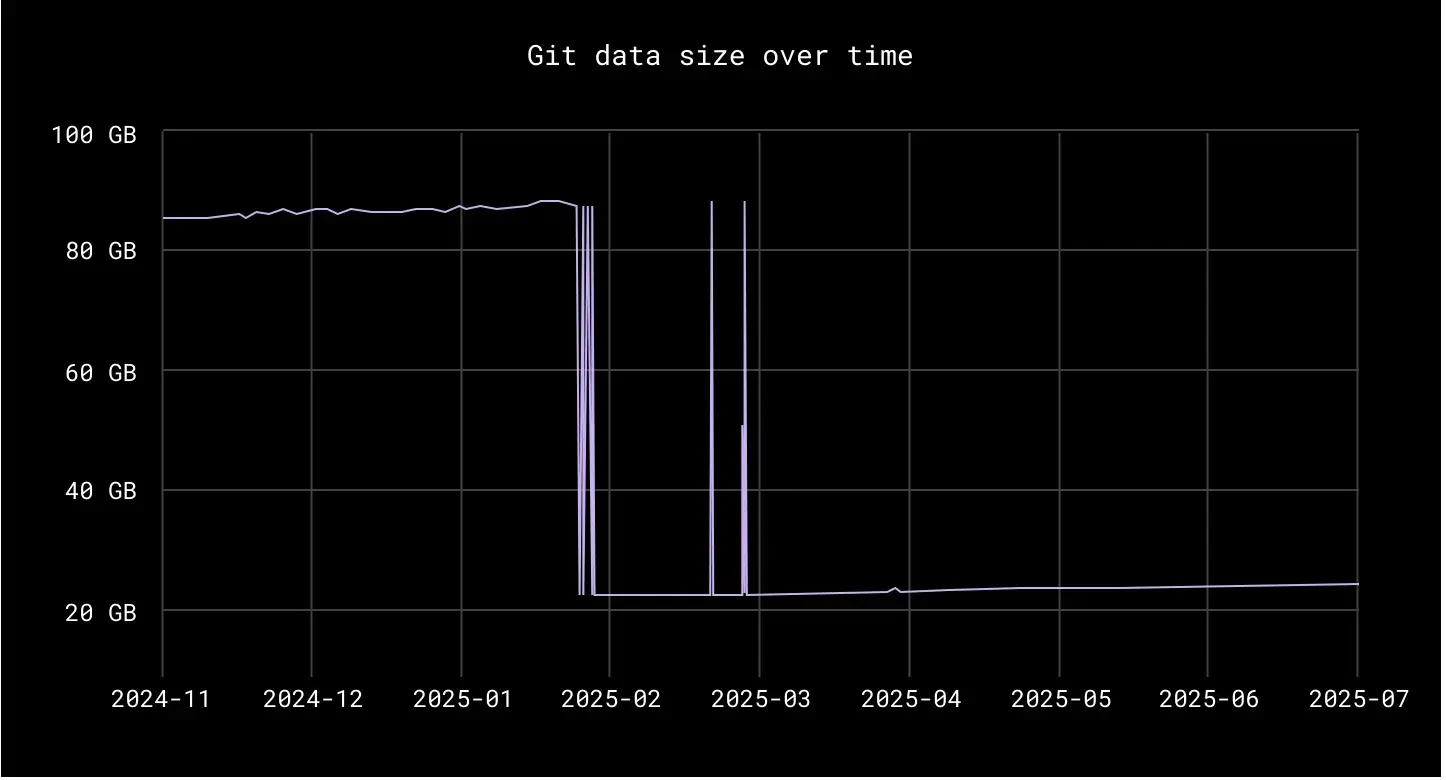
Following these optimizations, the repository size plummeted from 87 GB to 20 GB – a total reduction of approximately 77 percent. The impact on workflow was immediate: cloning time dropped from over an hour to less than 15 minutes, and CI pipelines accelerated due to reduced data transfer requirements. Beyond the speed gains, the project lowered the risk of hitting storage caps and simplified the onboarding process for new developers.
Visualizing data reduction at Dropbox through Git optimization.
Engineers at Dropbox emphasized that the most critical lesson learned was the necessity of viewing version control systems as vital infrastructure. At this scale, the internal behavior of storage tools directly dictates the speed of the entire development organization. The successful transition was made possible through tool-level tuning, cross-organizational cooperation with GitHub, and a cautious, staged validation process that protected existing developer workflows.