

The co-founder of WordPress asserts that new functionalities must demonstrate spectacular week-over-week user growth before they can be merged into the core system. A recent proposal to introduce a new “Knowledge” post type and a dedicated “Guidelines” feature failed to meet this strict criterion.
The proposal to integrate the new wp_knowledge post type alongside the Guidelines feature into the upcoming WordPress 7.1 release has been officially rejected. Co-founder Matt Mullenweg clarified that he strongly opposes adding core capabilities that have not yet established a substantial, real-world footprint among active users.
On Friday, WordPress 7.1 release lead Anne McCarthy officially announced the decision. She posted a direct comment on the merge proposal, which had been submitted by Greg Ziolkowski, an Automattic-sponsored contributor working within the Make WordPress Core project.
“The merge proposal was reviewed with Matt, and it became clear that it will not be implemented in version 7.1,” McCarthy wrote. She explained that Mullenweg’s current AI priority remains focused on evaluations and benchmarks linked to the WP Bench initiative, and he refuses to merge core features that lack proven traction – specifically, those without double-digit weekly growth.
“In its current form, this proposal does not meet those requirements,” McCarthy noted in her public response.
AI Team representative Jason Adams also reported the final outcome during Friday’s Slack meeting with the development team. Adams wrote that Guidelines would not make it into version 7.1 due to Matt’s reservations, but noted that they are still actively working on it at Automattic, with hopes of proposing it again in the future.
This final decision arrived just five days before the scheduled launch of WordPress 7.1 Beta 1. Within his original merge proposal, Ziolkowski had identified the freeze date as the critical moment when API routes, names, and capabilities become permanent compatibility guarantees for the platform.
The core concept behind Guidelines addresses a common issue – most websites operate under specific editorial policies governing tone, image choices, and language, which are usually stored externally in Google Docs or wikis. Originally introduced as an experimental Gutenberg feature in March, Guidelines gives site owners a settings page to anchor these standards directly inside WordPress, where editors, plugins, and AI tools can reference them.
However, Ziolkowski’s proposal aimed to go much further than that. Instead of shipping Guidelines as a standalone utility, he suggested building it on a broader database tier called wp_knowledge. This versatile post type would store notes, user contexts, and other plugin-defined data. Without this core primitive, he argued, every plugin developer would end up constructing their own fragmented storage, custom permissions, and REST API layouts.
This highly ambitious proposal sparked immediate pushback both in the pull request comments and across external communities – including the Dynamic WordPress group on Facebook, as reported by Search Engine Journal.
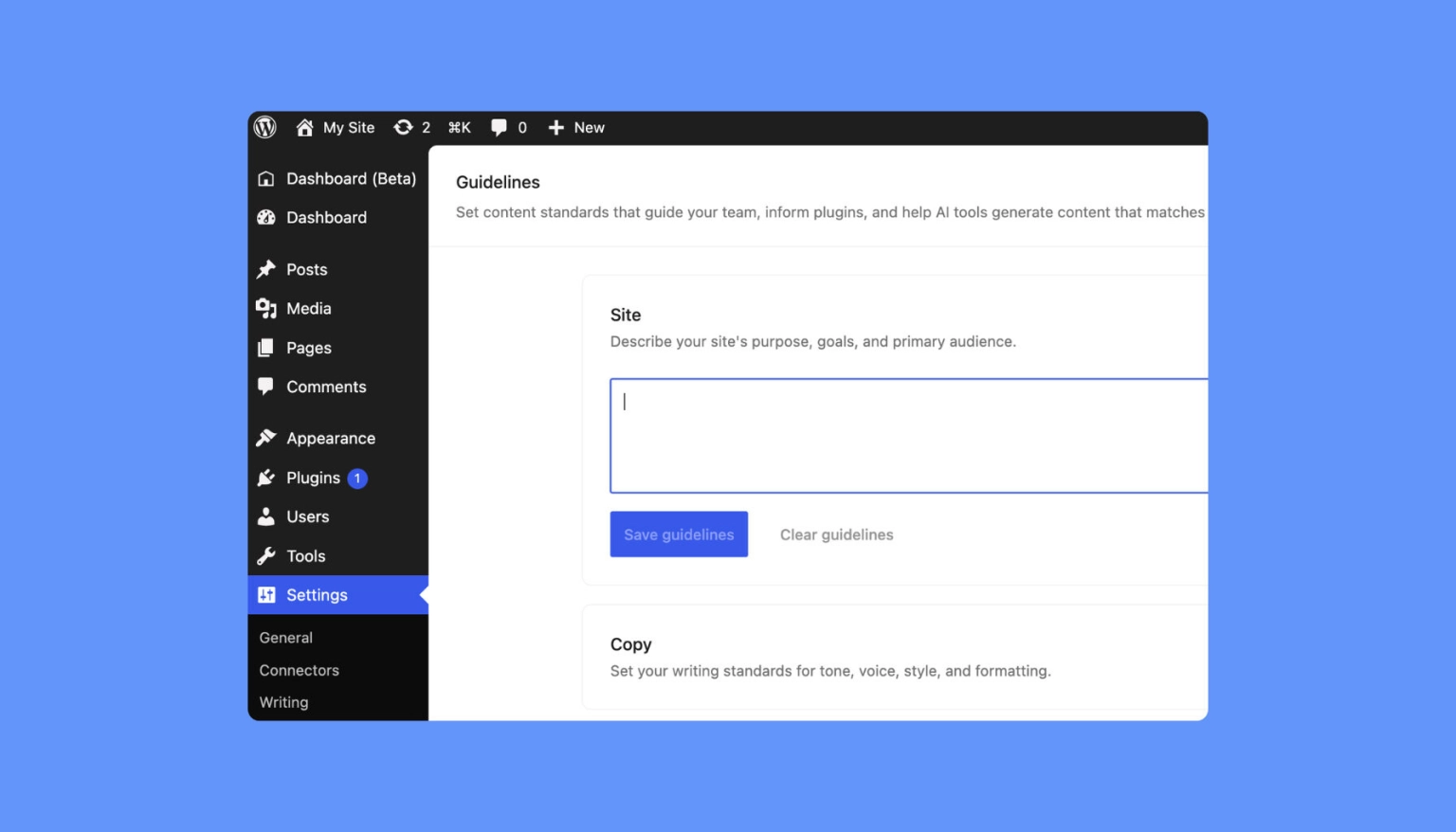
David Levin, a senior software engineer at rtCamp, criticized the proposal as premature and highly speculative. He argued that it differed substantially from Gutenberg’s existing Guidelines, adding that merging guidelines, memories, and notes under a single wp_knowledge supertype was too bold for a feature that hasn’t completed a full release cycle, suggesting a canonical AI plugin as the proper testing ground.
Developer John Brown dismissed the feature as entirely unnecessary for the vast majority of standard websites. He remarked that the concept should have been developed and tested as a feature plugin for a year or two first – and perhaps never merged into the core system at all.
Developer George Stefanis did not object to the concept but pointed out its heavy reliance on AI-driven workflows. Highlighting plugins like WP Help as examples this primitive could serve, he suggested emphasizing broader use cases to secure more support from the wider developer community.
Automattic engineer Arthur Piszek, who built a WordCamp Europe Telegram bot using Guidelines, defended the integration. He argued that the inactive post type leaves no digital footprint when unused, and stressed that WordPress needs a common convention before independent developers start creating incompatible layers of knowledge storage.
In his closing comments before McCarthy posted the final decision, Ziolkowski offered to narrow the scope by excluding the memory type as a built-in option, while defending his process by noting that Guidelines followed the official feature plugin pathway. However, none of this was enough. Mullenweg remained firm in wanting to see real-world adoption with impressive, double-digit weekly growth, which the proposal failed to demonstrate.
The release of the first WordPress 7.1 beta took place on July 15, while the final launch is scheduled for August 19 during WordCamp US in Phoenix.