
Microsoft has unveiled MDASH – a multi-agent security platform designed to automate large-scale code auditing across Windows and other Microsoft software environments. The system coordinates over 100 specialized AI agents working in concert to scan, validate, analyze, and confirm vulnerabilities within complex codebases. This represents a significant shift in how the tech industry approaches AI-driven security research.
The announcement signals a broader transition in cybersecurity. The focus has moved away from testing individual models toward integrated systems built around coordinated agent action, verification processes, and automated proof generation. Microsoft emphasizes that the infrastructure surrounding models matters more than any single model itself – particularly when dealing with massive proprietary codebases like Windows, Hyper-V, and Azure.
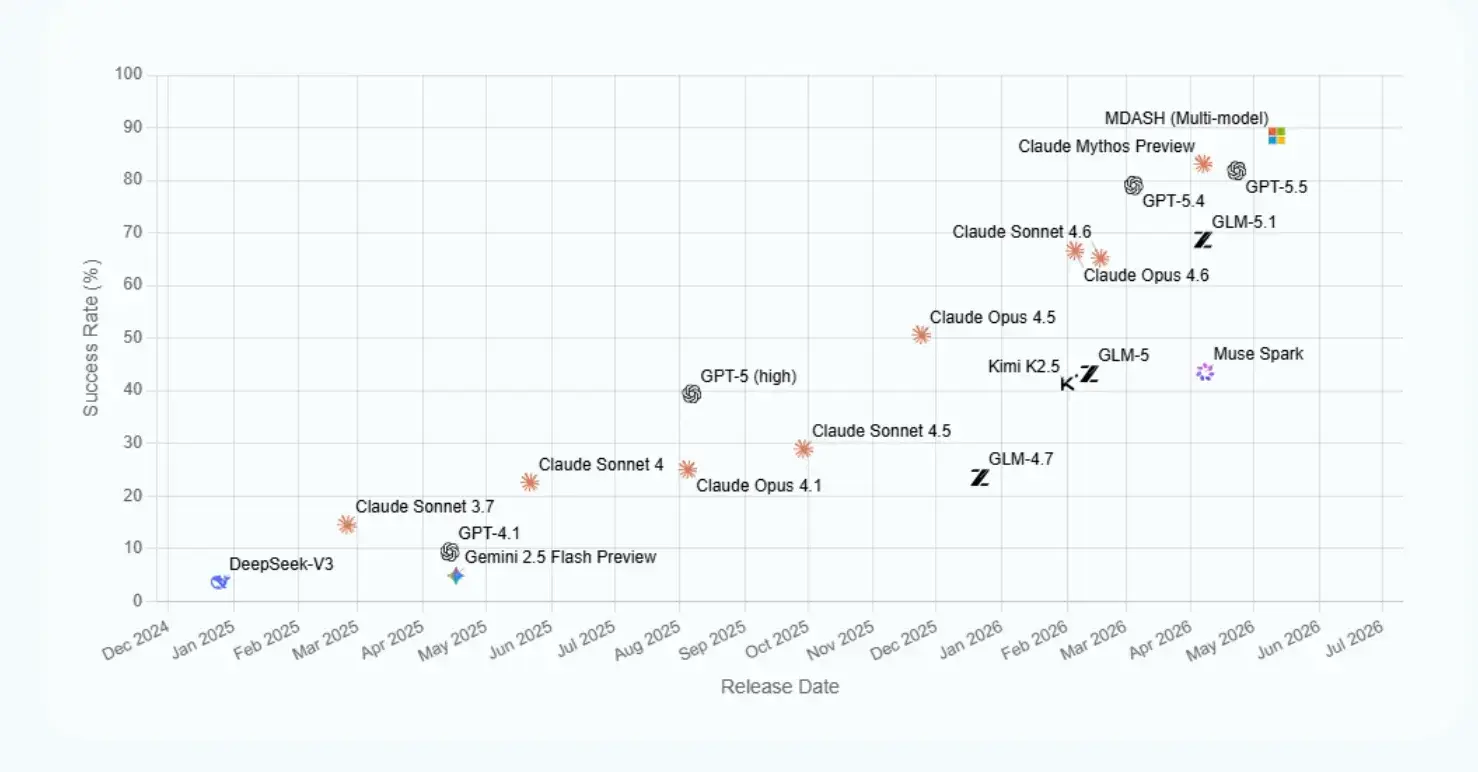
Performance metrics demonstrate MDASH’s effectiveness. On the public CyberGym benchmark covering 1,507 real-world vulnerabilities, the system achieved 88.45 percent accuracy – outpacing the next-best result by roughly five percentage points. Internal testing revealed 96 percent recall for clfs.sys vulnerabilities verified by Microsoft’s Security Response Center, and 100 percent recall for historical tcpip.sys cases.
Rather than relying on a single model or prompt chain, MDASH functions as a multi-stage pipeline. Specialized agents handle scanning, analysis, validation, deduplication, and exploitation independently. This architecture enables the system to analyze data across multiple files, identify lifecycle and concurrency errors, and determine whether a vulnerability has practical applicability rather than existing only in theory.
Infrastructure matters more than individual models
A central theme of Microsoft’s announcement concerns the future direction of AI security tools. They will depend less on raw model capabilities and more on orchestration systems built around those models. MDASH operates as model-agnostic technology, allowing teams to swap or upgrade models while preserving verification infrastructure, validation processes, and established workflows.
This approach introduces operational risks worth considering. On LinkedIn, researcher Sandesh K.S. raised important concerns about orchestration layer governance:
The orchestration layer is precisely where things become interesting – and dangerous. When specialized agents begin coordinating actions simultaneously across identity systems, financial monitoring, and cloud infrastructure, the blast radius from a single misconfigured permission boundary becomes enormous. Management layers need design before agent deployment, not fixes after the first incident.
Currently, MDASH exists in internal testing within Microsoft’s security teams and through limited closed-beta access with select customers. Organizations interested in evaluation can apply through Microsoft Security’s preview testing program.