

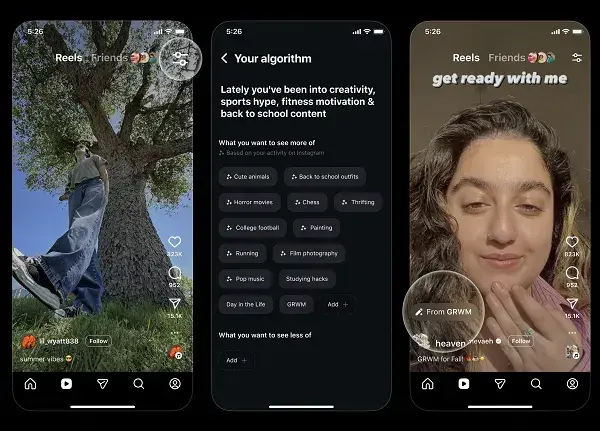
Instagram is giving users more say over what appears in their main feed. The platform announced that its Your Algorithm feature – which lets people specify what topics they want to see more or less of – is now expanding beyond Reels and Explore to cover the primary content stream.
The update hands users a direct mechanism to communicate preferences to the system rather than relying entirely on passive behavioral tracking.
The feature populates an initial topic list based on each user’s existing in-app activity. From there, people can adjust that list, and any changes feed back into the algorithmic parameters the platform uses to curate content for that account.
Your Algorithm first appeared as a Reels test in October 2025, then reached the Explore feed in April. Extending it to the main feed completes the rollout across Instagram’s three primary content surfaces, giving users a unified customization layer throughout the app.
The move carries real PR value. Addressing user frustration about algorithmic opacity – the sense that invisible systems decide what you see without any input from you – is something platforms have struggled with for years. Offering visible controls, even modest ones, tends to soften that criticism.
Most users won’t touch the settings. But having them available quiets a persistent complaint.
Instagram chief Adam Mosseri published his own take on algorithm-driven social media, reflecting on how the industry arrived at its current state and where user agency fits into the future of these platforms.
Mosseri acknowledged that the rise of AI-powered recommendations has come at a cost to personal control, weakening what once made social media feel genuinely social.
“Who you follow used to be a meaningful tool people had for shaping their own experience, and as recommendations took over the main feed that tool quietly stopped working. The conversation with the system became one-sided. The system learns from what you tap, watch, and share, but you don’t really get to tell it what you want. I think this is part of what people feel when they feel uneasy about social media — not the content itself, but the sense that the experience is happening to them rather than being shaped by them.”
Mosseri noted that AI has partially compensated for this by enabling more sophisticated content categorization and broader matching to inferred interests. But the process remains largely automated, limiting how much individuals actually shape their own experience.
He also pointed ahead to what he sees as a more radical shift coming – one where AI doesn’t just refine ranking but reconstructs the app experience itself around each person.
“Within a few years, AI will be capable of not only letting us see and shape algorithms, but also generating entire bespoke experiences on the fly, tailored to an individual in real time,” Mosseri said. “At that point you can imagine shaping much more than how ranking works in an app like Instagram — the structure of the app itself, the experiences inside it, even the things the app is for could be different for each of us.”
Mosseri frames this as liberating for users. What goes unaddressed is how Meta’s core interest – maximizing time spent in its apps – fits into a world where users genuinely control their own experience.
That tension is exactly what makes Your Algorithm a complicated bet. AI-powered recommendations currently generate all meaningful engagement growth across Meta’s platforms. Returning control to users runs counter to everything the company has optimized for.
If users actually adjusted their topic preferences in large numbers, engagement metrics could shift in ways Meta wouldn’t welcome. All available data shows that algorithmic curation – regardless of how users feel about it – drives higher usage than manual control ever has.
Meta’s underlying assumption seems to be that users will demand these controls loudly and use them sparingly. History supports that assumption.
In this light, features like Your Algorithm function less as genuine control mechanisms and more as reassurance. Social apps understand that convenience is what users actually optimize for in practice, not customization.
That expectation of convenience has become the default contract between users and social platforms. People now assume the system will learn from their behavior and serve relevant content automatically. Apps that don’t deliver on that expectation lose users to ones that do.
Mosseri’s vision of AI enabling deeper personalization sits in interesting tension with this reality. His argument frames AI as a tool for building richer individual experiences. The evidence suggests most people want the simplest possible path to content – sign in and scroll.
The option to customize will exist. Most users will never open it.
People trust smart systems to understand them better than they understand themselves – at least when it comes to what to watch next. Building tools that challenge that assumption is technically interesting but practically optimistic.