
AI-generated spam has become a massive hurdle for major social networks. Sophisticated AI models can now mirror human interaction and produce realistic visuals, clouding online conversations.
Which social platforms are suffering most from this artificial intelligence influx?
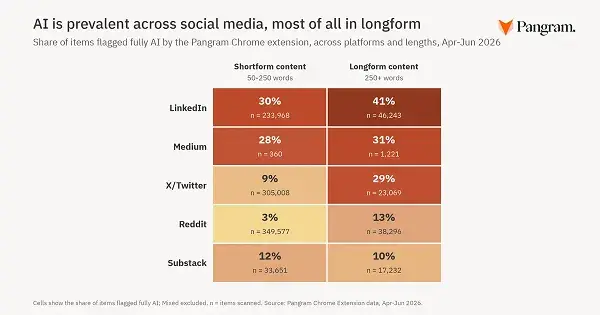
LinkedIn leads, with a recent report indicating that 41% of long-form posts on the app show signs of AI generation.
The data comes from Pangram, a tech firm behind a browser extension for detecting online AI content. While 100% accurate detection software does not exist – making exact scale hard to measure – Pangram’s averages place LinkedIn first, followed by X, where about a third of long posts appear AI-written.
All platforms face synthetic spam. Pinterest took action against an influx of AI posts that users said flooded their feeds, becoming the sole platform so far to add an AI toggle allowing members to limit AI-generated content.
Meanwhile, Reddit recently shared details on its efforts to combat rising AI-generated comments and automated activity.
X has also acknowledged operational difficulties when dealing with artificial intelligence content.
In March, X Head of Product Nikita Bier announced changes to creator monetization rules. The update targeted a sharp spike in AI deepfakes linked to the war in Iran.
Both Bier and X owner Elon Musk spoke about the growing threat of AI bots on social apps. In March 2023, Musk posted on X that AI advances made preventing bot armies nearly impossible, as creating 100,000 human-like bots costs under a cent per account.
In response, Musk proposed charging all users access fees, assuming even a small payment would restrict mass bot creation.
Yet too few users showed interest in paying for X. Paid social services have generally never enjoyed broad popularity.
At LinkedIn, anti-AI measures included reducing audience reach when AI-generated spam was detected.
Nevertheless, most social platforms invest heavily in AI projects, wanting users to integrate AI tools rather than disable them.
Meta, for example, invested hundreds of billions into AI development to become a global technology leader.
However, Meta users are not enthusiastic about the AI tools constantly pushed onto them.
Today, Facebook and Instagram users are regularly prompted to use Meta AI to ask questions, generate images, and draft posts.
When Instagram head Adam Mosseri recently announced the integration of the latest Muse image tools, replies to his Instagram post were almost universally negative.
Comments featured phrases like “AI horror,” “We need an AI toggle,” and “Nobody asked for this.” Such feedback reflects growing dissatisfaction with AI tools in entertainment.
This response is unsurprising, as AI tools are the exact opposite of social media engagement.
Social networks were built on connection – specifically human communication. Meanwhile, AI tools only replicate interaction through simulated personas, while AI images and videos replace real human experiences, art, and life events.
What is the point of social apps if nothing published is true and they no longer serve as outlets for personal experience and connection?
If most online information turns out to be fake, trust across the network collapses, weakening the core advantage of social networks until it vanishes.
Social networks then turn into mere entertainment apps, endlessly releasing videos from unknown creators as smaller screens replace televisions.
This seems to be a real trend. In that case, what even represents a social network app in the AI era?
Can messaging apps now be considered social networks? That is where people communicate, serving as the last place for real online interaction.
Yet this reduces the value of social networks as communication tools, turning them into curated entertainment apps. In this paradigm, AI content may not prevail, as vast output keeps quality an issue – for every cool Harry Potter video, thousands of dull images feature legs in weird places, exaggerated facial expressions, and un-synced lip sync.