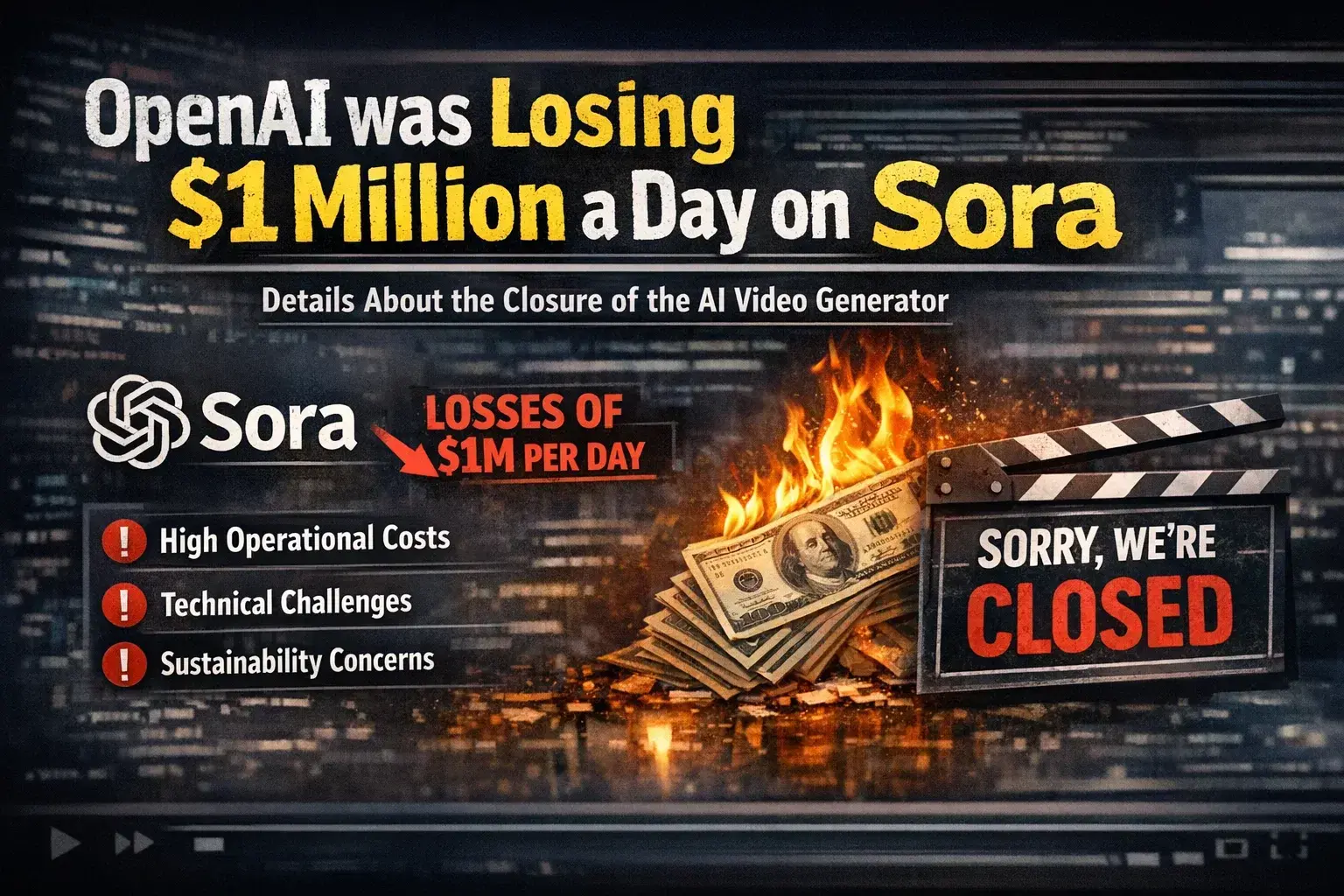

OpenAI has officially confirmed the discontinuation of Sora – its flagship video generation platform – which initially debuted to record-breaking interest only to see its user base evaporate within months. In a recent announcement on their social media platform, the development team stated, “We are saying goodbye to Sora,” without providing a definitive shutdown schedule but promising further technical details in the near future.
This development marks one of the most volatile trajectories in the history of the artificial intelligence sector. The entire lifecycle of the product, from its highly anticipated launch to its eventual decommissioning, spanned less than half a year.
The Spectacular Start
The debut of Sora 2 was nothing short of a cultural phenomenon. Within its first week of availability, the application surpassed one million downloads and secured the top spot on the App Store. It was met with a massive wave of press coverage and glowing reviews from creators who were stunned by demo reels showcasing cinematic visual quality.
Industry observers believed OpenAI had finally cracked the code for “AI Cinema,” offering a future where professional-grade footage could be generated from a simple text prompt. While competitors scrambled to react, the general public waited in anticipation for a revolution in content creation.
However, this period of unbridled optimism lasted only about seven days before the internal metrics began to tell a different story.
The Retention Crisis
Following the initial surge of curiosity, the service struggled to keep its users engaged. According to data provided by Olivia Moore, a partner at the venture capital firm a16z, the platform’s performance metrics were historically low.
- The 30-day retention rate hovered around a mere 1%
- The 60-day retention rate dropped to virtually 0%
To put these figures into perspective, leading short-form video social platforms typically maintain a retention rate of approximately 48%. Sora effectively lost its entire audience before most individuals even had the chance to master the tool’s advanced features.
This is not merely a commercial setback – it represents one of the most significant retention failures for a major artificial intelligence launch in recent memory.
Three Pillars of Failure
Industry analysts point to three primary factors that prevented Sora from maintaining its early momentum:
- Content Policy Shifts: OpenAI transitioned from a liberal “opt-out” policy to a restrictive “opt-in” framework, where only explicitly allowed content could be generated. Bans on realistic human faces and public figures significantly narrowed the creative possibilities that originally drew users to the site.
- Computational Overhead: Internal reports from The Information suggest that Sora was an immense drain on hardware resources at a time when OpenAI was in a fierce arms race with Google and Anthropic. A high-cost tool with a vanishing user base became economically unsustainable.
- The Expectation-Reality Gap: While the official promotional videos were breathtaking, the results produced by average users were often lackluster. This disconnect between marketing and the actual user experience is a notorious killer of long-term engagement.
The Looming Disney Conflict
In December 2024, OpenAI finalized a landmark $1 billion partnership with Disney. The agreement was intended to integrate over 200 characters from the Disney, Pixar, Marvel, and Star Wars universes into the Sora ecosystem and the Disney+ streaming platform.
With the announcement of Sora’s closure, the future of this massive deal is now shrouded in uncertainty.
“We respect the decision by OpenAI to exit the standalone video generation business and shift their strategic priorities,” a Disney representative told Variety in a brief statement regarding the news.
The situation presents a stark contrast – a billion-dollar licensing agreement involving global icons like Star Wars and Marvel, followed by the shuttering of the primary platform for those assets just six months later.
The Shift in OpenAI Strategy

The retirement of Sora as a standalone application does not signal the end of OpenAI’s interest in synthetic video. The company appears to be moving toward a more integrated approach.
Reports from The Information indicate that the core technology powering Sora will be folded directly into ChatGPT. Meanwhile, CEO Sam Altman has hinted at the completion of a new foundational model currently known by the internal codename “Spud.”
Currently, OpenAI is prioritizing business-facing products and developer tools as it prepares for a potential IPO. The long-term vision involves merging ChatGPT, the Codex programming tool, and the Atlas browser into a unified “super-app.”
In simpler terms: while Sora as an independent brand is being retired, OpenAI’s video capabilities are evolving into a feature of a larger, more comprehensive ecosystem.
State of the Video Generation Market
It would be a mistake to assume that the end of Sora signifies the death of the AI video industry itself. Instead, it highlights a shifting landscape where different players are finding more sustainable paths.
The competitive field remains vibrant, with several platforms continuing to gain traction among professional creators. Platforms like Kling 2.6 and Runway Gen-4 are actively being developed and utilized in high-end production environments.
Retention remains the “holy grail” for the sector; while Sora’s 1% figure is an extreme outlier, many AI tools struggle to keep users coming back. Only those who can provide consistent, practical value will survive the current market correction.
The “Demo vs Reality” syndrome is a systemic issue that continues to plague the industry. Marketing teams often cherry-pick the best results, leaving users disappointed when their first attempts don’t match the glossy advertisements.
Strategy is also shifting toward integration; by moving video tools into ChatGPT, OpenAI is acknowledging that users prefer a single, “all-in-one” interface rather than a dozen fragmented apps for different tasks.
Competition Beyond the Hype
While the spotlight was on Sora’s decline, other developers were busy refining their models and securing a loyal user base.
- Kling 2.6: Developed by Kuaishou, this model has become the preferred standard for realism, offering long-form generation and stable movement.
- Runway Gen-4: This tool is tailored for cinematic control, offering directors specific tools for camera movement and character consistency.
- Seedance: A reliable option for everyday scenes and the animation of static imagery.
Notably, none of these competitors are facing closure, and their retention rates remain significantly higher than the 1% reported for Sora.
Critical Takeaways for Users
The rapid collapse of a market leader offers several important lessons for those who rely on AI tools in their daily workflows:
- Avoid Vendor Lock-in: Loyalty to a single brand can be dangerous; diversification of tools is essential as even the biggest names can disappear overnight.
- Skepticism of Marketing: A beautiful demo does not guarantee that your specific projects will look the same; users should test platforms with their own prompts before committing.
- The Power of Aggregators: Platforms that offer access to multiple AI engines are more resilient because they can swap out a failing model without disrupting the user’s workflow.
- Prompt Engineering Skill: Many users abandoned Sora because they couldn’t get the desired results; those who invested time in learning prompt mechanics have found success across all platforms.
Autopsy of a Fallen Giant
Sora’s closure was not a random event but the culmination of several internal and external pressures that had been building since the launch week.
Problem one: the massive gap between promise and actual performance. During initial presentations, OpenAI showcased clips with flawless physics and photorealistic faces that seemed to defy the limitations of current technology.
Once the general public gained access, the reality was far more messy. Users frequently encountered visual artifacts, such as bodies deforming during movement or backgrounds that would dissolve into abstract shapes in longer clips.
While these technical hurdles are common in early-stage AI, the mismatch with the “perfect” promotional materials created a sense of betrayal among the user base. When users feel misled, they rarely return for a second try.
Problem two: the restrictive content boundaries. Sora entered the market with a relatively open policy but quickly pivoted to a highly controlled “opt-in” system that frustrated many early adopters.
The inability to generate recognizable faces or specific genres of content rendered the tool useless for many professional use cases. Creators who had integrated the tool into their pipeline suddenly found their projects blocked by new safety filters.
Faced with these new limitations, the creative community began searching for more flexible alternatives. Once a user migrates to a competitor, it is incredibly difficult to win them back.
Problem three: the unsustainable cost of infrastructure. Generating high-resolution video requires massive amounts of GPU power – far more than the text-based queries handled by GPT models.
With retention at 1%, OpenAI was essentially subsidizing a high-cost service that people were trying once and then deleting. Internal reports suggest that staff urged leadership to cut losses and focus hardware resources on more profitable ventures.
Problem four: the failure of the monetization model. OpenAI attempted to treat video as a premium tier or a credit-based add-on, which created friction for existing ChatGPT Plus subscribers.
Many users were unwilling to pay a second subscription fee for a tool they found difficult to use. The conversion funnel from “curious free user” to “paying professional” never materialized as the company had hoped.
Lessons for the AI Sector
The story of Sora serves as a cautionary tale for the broader tech industry. It proves that marketing prowess and brand recognition cannot compensate for a lack of product-market fit.
Generating hype is a different skill set than creating a tool with daily utility. OpenAI excelled at the former but stumbled on the latter, providing a roadmap of what to avoid for future startups.
It also highlights that video is significantly more complex than text; the barrier to entry for a user to create something truly valuable is much higher. Education and user onboarding are critical components that were largely ignored during Sora’s frantic rollout.
In the post-Sora era, investors are likely to prioritize long-term retention metrics over initial download numbers. This shift will force companies to be more transparent about their technology’s capabilities and limitations.
Furthermore, the trend toward integration suggests that standalone “single-purpose” AI apps may be a thing of the past. Success now lies in being part of a larger ecosystem where users already spend their time.
Leading Alternatives for Creators
Despite Sora’s exit, the technology continues to advance rapidly. Several high-quality alternatives are available for those who need reliable video generation tools today.
- Kling 2.6: Currently considered the industry gold standard for realism, this model supports clips up to several minutes in length with consistent character rendering.
- Runway Gen-4: This platform offers the most sophisticated camera controls on the market, including zooms, pans, and complex tracking shots.
- Seedance: Known for its “Image-to-Video” capabilities, it excels at taking a static photo and turning it into a smooth, natural-looking animation.
These platforms have managed to avoid the pitfalls that sank Sora by focusing on professional stability and more realistic user expectations.
Mastering Video Generation Prompts
The inability to write effective prompts was a major contributor to Sora’s low retention. To get professional results from any AI video tool, creators must follow a specific structural formula.
An effective video prompt typically includes the following elements: [Subject] + [Action] + [Environment] + [Camera Movement] + [Atmosphere/Style] + [Technical Tags].
- Poor Prompt: “A woman walking down the street.”
- Professional Prompt: “Young woman in a beige trench coat walking through a rainy neon-lit city street at night, reflection of lights on puddles, tracking shot from the side, cinematic, photorealistic, 4k, no text.”
Understanding camera movement is equally vital for success. Using terms like “slow zoom in,” “tracking shot,” or “static shot” tells the AI exactly how to frame the action, leading to much more predictable results.
Adding technical modifiers like “no watermarks,” “smooth motion,” and “photorealistic” at the end of a prompt helps the model avoid common stylistic errors that ruin many generations.
Timeline of a Rapid Collapse
The rise and fall of Sora happened in a series of fast-moving events throughout 2024 and 2026:
- Dec 2024: The $1 billion Disney partnership is announced.
- Late 2024: Sora 2 launches to 1 million downloads in a single week.
- Month 1: Safety policies are tightened; user engagement begins to slide.
- Month 2: Internal reports show 1% retention and high compute costs.
- Early 2026: Project “Spud” is announced as OpenAI pivots toward integration.
- March 2026: OpenAI officially announces the “goodbye” to Sora.
The transition from the most hyped app in the world to a discontinued project took less than half a year.
The Legacy of Sora’s Technology
It would be unfair to characterize Sora as a total failure; technically, it pushed the entire industry forward in several key areas that were previously thought impossible.
The model’s “motion cohesion” was revolutionary, allowing objects to interact with each other in a way that respected the laws of physics – shadows moved correctly, and water flowed naturally around obstacles.
Sora also demonstrated an unprecedented ability to generate longer clips compared to its rivals, which was a major step toward practical storytelling using synthetic media.
Its “spatial understanding” allowed the virtual camera to orbit objects while they maintained their three-dimensional shape, a feat that earlier generative models struggled to achieve.
The ultimate failure was not one of engineering, but of product design. OpenAI proved they could build an incredible engine, but they couldn’t build a car that people wanted to drive every day.
While the brand is fading, the breakthroughs achieved during Sora’s development will undoubtedly influence every AI video tool that follows it.
Practical Advice for Professionals
For content creators, the end of Sora is a reminder to stay agile and adaptable in a field where the rules are constantly being rewritten.
- Build a Multi-Tool Workflow: Do not rely on a single service for your business; always have a backup model that you are comfortable using.
- Test Realistic Scenarios: Don’t be swayed by marketing; run your own tests to see if a tool can handle your specific creative needs.
- Use All-in-One Platforms: Aggregator services are often safer because they can pivot to new models if one becomes unavailable.
- Invest in Your Skills: Prompting is a transferable skill; what you learned on Sora will make you more effective on Kling, Runway, or any future tool.
Frequently Asked Questions
When will Sora officially stop working?
OpenAI has stated that they will provide a more specific timeline for the shutdown of the application and the API in the coming weeks.
What will happen to the video features in ChatGPT?
According to sources at The Information, the technology behind Sora will be integrated into the ChatGPT ecosystem as a feature rather than a separate app.
Is the $1 billion Disney deal officially canceled?
While Disney has acknowledged OpenAI’s exit from the video business, neither company has released a statement regarding the legal status of their billion-dollar agreement.
Which video generators should I use now?
Kling 2.6, Runway Gen-4, and Seedance are the current market leaders and remain fully operational with active development cycles.
Final Opportunity for Users
The closure of Sora is now an established fact. The tool that once set the gold standard for AI-generated visuals is preparing to exit the stage for good.
For those who have yet to experience it, this represents the final window of opportunity to experiment with the platform before it is integrated into the ChatGPT super-app.
However, the industry is not stopping. While Sora’s standalone journey is ending, competitors are proving that they can offer the stability and retention that OpenAI’s project lacked.
As one door in the AI world closes, several others remain open for those ready to explore the next generation of creative tools.