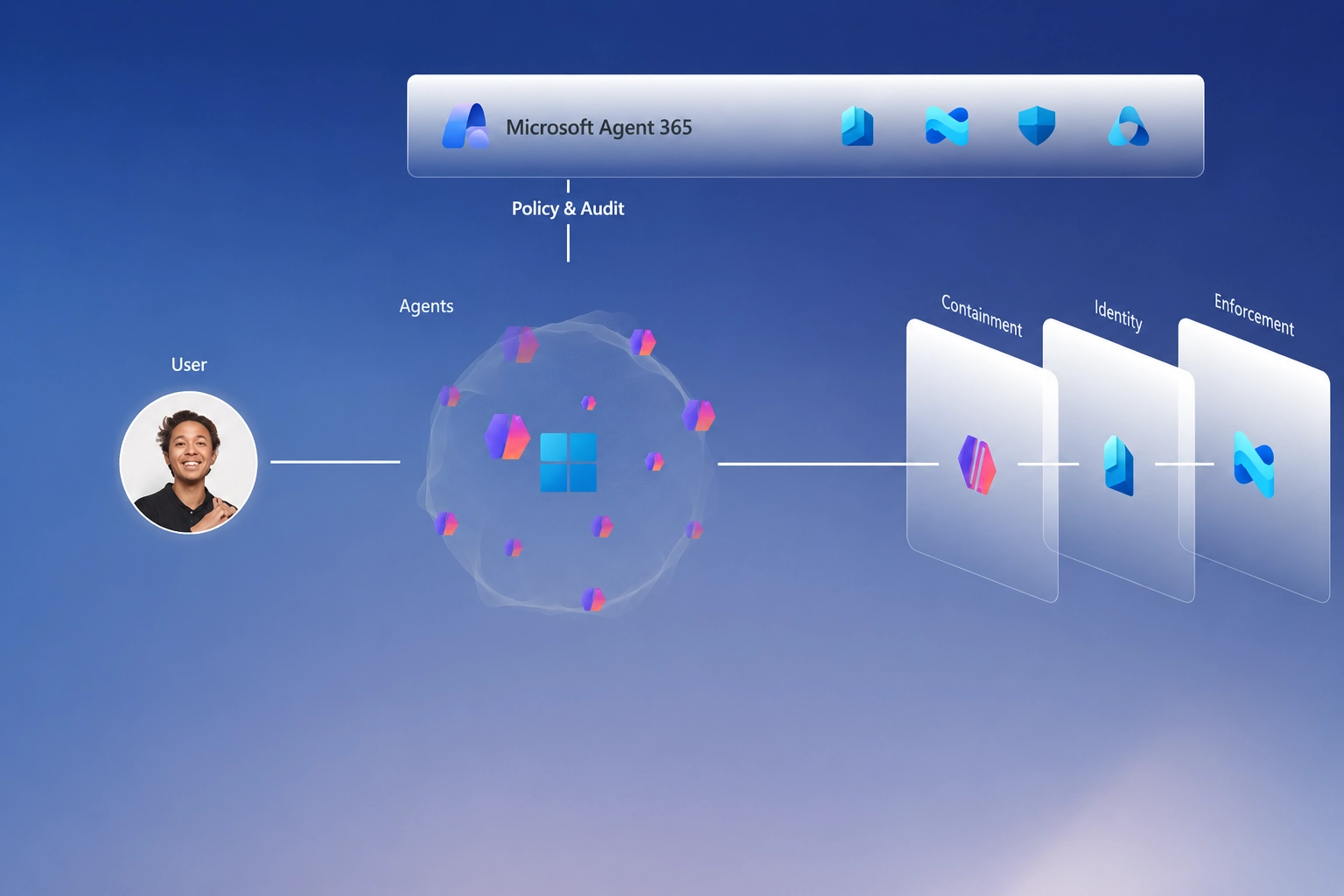

Microsoft published a new developer blog post titled “Windows Platform Security for AI Agents,” positioning the operating system as a trustworthy foundation for autonomous agents. At the center of this strategy sits the Microsoft Execution Containers SDK, known as MXC. The company argues that isolation, identity, and manageability need to be built directly into the operating system itself – not bolted on afterward – if agents are going to deploy and operate safely at scale. The blog outlines a spectrum of isolation mechanisms ranging from process and session isolation up through scheduled micro-virtual machines and Linux containers, all governed under MXC policy.
MXC functions as a policy-managed execution layer for agents running on Windows and WSL, abstracting away lower-level isolation primitives entirely. Developers define what an agent can access either through JSON configuration or via a TypeScript SDK. Windows handles isolation through process separation, while session isolation kicks in when agents require dedicated desktops and accounts. Future plans include micro-virtual machine support for higher-risk operations and Linux containers for toolsets dependent on Linux environments. Integration with Windows 365 is also planned, enabling agents to run certain workloads on cloud PCs. IT teams will reportedly manage MXC policies centrally through Entra ID and Intune, while Defender and Purview provide protection, observability, and audit logging of agent behavior.
In Windows, capability, identity, and manageability are foundational principles that extend security beyond the application and model to the entire operating system.
— Dana Huang
The blog also frames the agent model as building on years of existing security investments – Secure Boot, passwordless authentication, hot-patching, memory-safe drivers, and post-quantum cryptography already present in Insider builds. Agents inherit this secure foundation, with Defender adding protection against prompt injection and other agent-specific threats. The argument emphasizes distinct agent identities, least-privilege access, and tool calls routed through a proxy server.
Industry coverage has focused heavily on MXC’s structural design. CSO Online’s reporting notes that MXC offers several internal architecture options, all unified under a single configuration and SDK. A separate analysis of Microsoft’s Build conference announcements argues that integrating MXC into Windows and WSL represents part of Microsoft’s broader effort to reposition the operating system as a controlled execution environment for both AI agents and human users alike.
Early commentary treats MXC with notable caution rather than as a finished security solution. A technical review on byteiota.com points out that the same policy schema is expected to work across Windows, Linux, and macOS, though macOS support remains experimental at this stage. The review cites Microsoft’s own documentation warning that MXC profiles shouldn’t yet be treated as security boundaries, and flags known instances of overly permissive policies that still need addressing. Outbound network filtering also doesn’t yet function properly – a significant gap, given that compromised agents frequently manifest through data exfiltration.
An agent’s value is determined not just by its capabilities, but by how much it can be trusted throughout its operation.
— Dana Huang
Cloud providers, Linux developers, and independent projects are pushing platform security for agents forward on other fronts too. Beyond the Windows ecosystem, Linux-based platforms are moving in a similar direction, often emphasizing kernel-level or hardware-based isolation more heavily. NVIDIA’s OpenShell runtime is described as a secure, private execution environment for autonomous agents, combining sandboxed runtime controls with declarative policies to prevent unauthorized file access, data leakage, and uncontrolled network activity. NVIDIA’s developer guide demonstrates kernel-level isolation, with filesystem, network, and process-level controls enforced within a sandbox designed for long-running, self-evolving agents. Red Hat has announced integration of its AI platform with OpenShell, alongside confidential containers and SELinux enforcement as part of a zero-trust model for enterprise AI agents operating in hybrid cloud systems.
Numerous projects and guides have emerged around agent sandboxing within Kubernetes specifically. An InfoQ article on the Agent Sandbox controller describes a Kubernetes add-on leveraging gVisor and, when needed, Kata Containers to isolate untrusted agent code within secured pods. This approach specifically draws on OWASP guidance for system isolation and permission management. A separate, more recent InfoQ report on Azure Container Apps sandboxes examines Microsoft’s parallel work building micro-VM-based sandboxes for untrusted agent code in the cloud, where each sandbox runs within a hardware-isolated micro-virtual machine with outbound traffic blocked by default through a proxy server.
Linux distributions and security vendors are also leveraging native primitives – cgroups, namespaces, seccomp, Landlock, and eBPF – to build sandboxes tailored specifically for agent workloads. Agent execution sandboxes running within standard containers share a single host kernel, while secure agent execution in production environments often demands hardware-level isolation through micro-virtual machines or user-space kernels combined with strict filesystem and network policies. The Guardian Shell project, for instance, runs agents in isolated cgroups using Landlock, seccomp, and eBPF mechanisms that enforce per-agent policies at the kernel level without requiring any modification to the agent’s code. This approach attempts to layer agent-specific controls onto existing Linux security modules and container runtimes, rather than introducing an entirely new SDK and policy layer into the operating system itself.
For security teams, the central takeaway is that no single dominant platform security model for AI agents has yet emerged. Windows’ preview version of MXC delivers OS-integrated, policy-managed access restriction within the Windows and WSL world, but Microsoft’s own documentation and independent analysis both stress that this remains early-stage software – not something that should be treated as a complete or final security guarantee. Linux and Kubernetes already offer kernel-level and hardware-supported alternatives, including OpenShell, gVisor, Kata Containers, and cloud-based micro-virtual machine sandboxes.