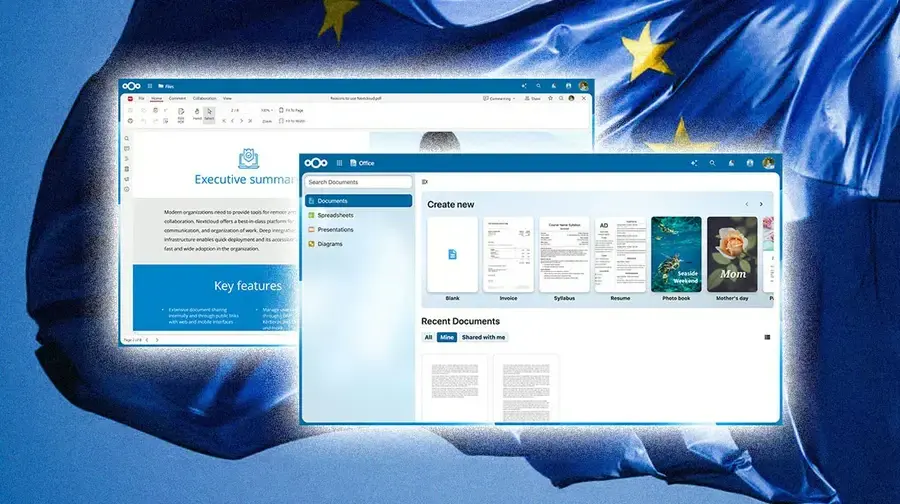

Europe is taking a decisive step toward digital independence from US and Chinese tech dominance. On June 9, Euro-Office – a brand-new open-source suite positioned as an alternative to Google Docs and Microsoft Office – will be released to the general public. CyberNews first reported the upcoming launch, citing an announcement from Nextcloud.
The platform operates not as a standalone productivity suite, but as a web editor natively integrated into the ecosystems of its participating providers. It is the result of a massive collaborative effort among European tech firms and organizations, including IONOS, Nextcloud, Eurostack, XWiki, OpenProject, Soverin, Abilian, BTactic, OpenXchange, and Office.eu.
Users can view and edit documents, spreadsheets, and presentations in real time, according to the project’s GitHub profile. Supported file formats include DOCX, PPTX, PDF, and TXT. While Nextcloud clients can access Euro-Office immediately on June 9, France-based XWiki is expected to integrate the solution by the end of 2026.
“The next step is to work on desktop and mobile applications, as well as integration features. For a truly sovereign solution, it is also important to fully support open standards, such as ODF formats, and this will be one of the priorities for the next release,” says Nextcloud CEO Frank Karlitschek.
First announced on March 27, the initiative has generated substantial interest alongside its fair share of controversy. Euro-Office is built upon code from OnlyOffice, an open-source suite whose developers have already alleged licensing violations. At the same time, full cooperation with OnlyOffice was deemed impossible due to product opacity and its historical ties to Russia.
OnlyOffice is currently held by Latvia-registered Ascensio System SIA, which claims its Russian business branch was sold to domestic investors back in 2019, where a forked version exists as R7-Office. According to the company’s website, OnlyOffice and R7-Office have functioned as completely independent products since 2023, sharing no code base, ownership, or ongoing cooperation.
The debut of Euro-Office represents a broader European movement toward “digital sovereignty,” which seeks to mitigate dependence on foreign technology. Local and national governments in France, Germany, and Austria have already transitioned away from Microsoft software or committed to doing so.
Data privacy fears remain the primary catalyst for this shift. US legislation forces American corporations to surrender data to domestic law enforcement regardless of where it is hosted. Highlighting these tensions, Microsoft was recently accused of transferring data from Dutch civil servants – who are currently working on EU digital regulations – directly to the US House of Representatives.